
Boise Directory Collections by Year
The downtown Boise Public Library local-history collection is the main Boise city directory shelf. It holds printed local history, maps, clipping files, and several kinds of name or address lists. The Idaho State Archives catalog adds selected Polk volumes and county-wide editions. Coverage is not the same as a complete digital run, so note the keeper, year, and format before drawing a conclusion.
| Boise collection | Years shown | Where kept | How to use it |
|---|---|---|---|
| Polk city directories | 1891 to the current run | Boise Public Library | Third-floor shelf or paid staff lookup |
| Telephone books | 1948 to the current run | Boise Public Library | In-person research or staff request |
| Hill-Donnelly cross-reference directories | 1969-1970, 1872-1991, and 1993-2004 as printed by the library | Boise Public Library | Ask staff to confirm the unusual displayed runs |
| Selected R.L. Polk holdings | 1902-03, 1917, 1927, 1939/40, 1955, 1969/70, plus later cataloged runs | Idaho State Archives | Catalog research; some items are not for loan |
A library worker can check one name or business in one year for $1.25 per directory page, with a five-page weekly limit. That option matters when a Boise volume is not online. Exact fields vary by publisher and year, and the research session did not reproduce a privacy-safe sample entry. Confirm the page itself before quoting it.
See the library's genealogy and local-history databases before visiting.
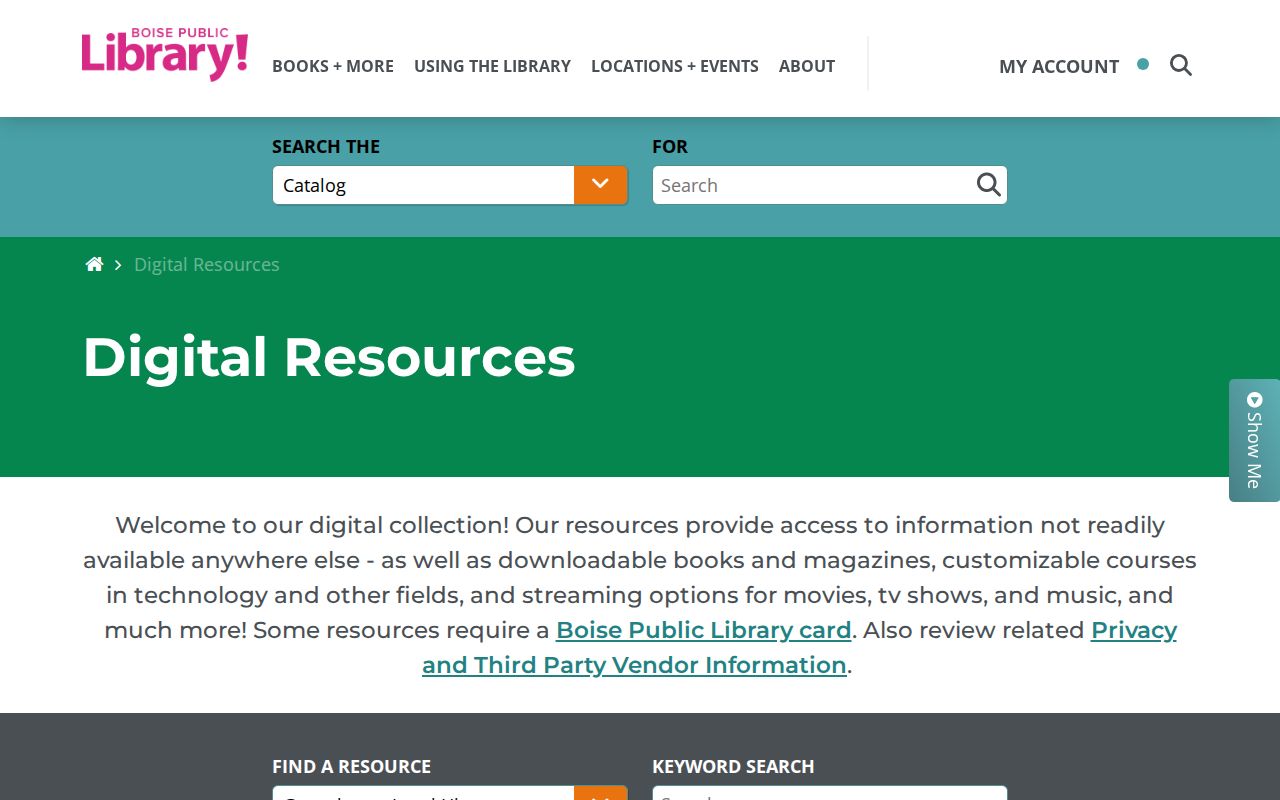
The captured resource page shows the digital bridge into archives, newspapers, clipping files, and Sanborn maps, while the printed Boise directories remain a separate shelf resource.
Boise's Library Directory Trail
Boise's library began as a subscription library and free reading room in City Hall on February 18, 1895. It moved to a Carnegie library on June 22, 1905. That local story helps explain why old Boise city directory research still leads to a library rather than one government database. The Polk run begins close to the library's earliest years, and the collection grew alongside newspapers, phone books, maps, and clipping files.
The downtown third floor is the practical in-person route. For remote work, submit a narrow request with one name or business and one year. The same service offers obituary or death-notice searches and Idaho Statesman article requests for $5.25 each, with four such requests per week. A tight question costs less and gives staff a fair chance to locate the right page.
Note: Directory availability and service fees were inspected August 23, 2026; confirm both with the library before ordering a lookup.
Decode a Boise Directory Entry
A printed entry is a dated statement, not proof of continuous residence. Depending on the volume, it may identify a person, household relationship, business, phone subscriber, mailing point, or street address. Photograph the title page and abbreviation key with the entry. Without those pages, a short code can be easy to misread.
| Printed name | Copy spelling, initials, suffix, and any household notation exactly. |
|---|---|
| Work or affiliation | Record the printed occupation or business label without treating it as current. |
| Street line | Keep the house number, direction, street type, and unit as printed. |
| Phone or status mark | Note it only when present; not every year uses the same convention. |
| Source citation | Save publisher, year, page, collection, and whether the record is print, microfilm, or image. |
- Criss-cross directory
- A later directory arranged by street or phone rather than only by surname.
- Householder index
- An address-led list used to connect a house or unit with the person printed for that year.
- Abbreviation key
- The publisher's legend for short forms and symbols. Read it before expanding any code.
A blank year is not proof that someone left Boise. A person could be unlisted, the volume could be missing, or the publisher could have carried different classes of entries.
Search Boise's Digital Archives
The Boise City Archives Digital Collection provides search and browse access to digitized city-history objects. The physical archives also hold maps, photographs, personal papers, municipal collections, and finding aids. Many collections are still being processed. An empty web result therefore means only that the digital search did not return an item.
The Idaho State Archives searchable catalogs provide another route into Boise and Ada County material.
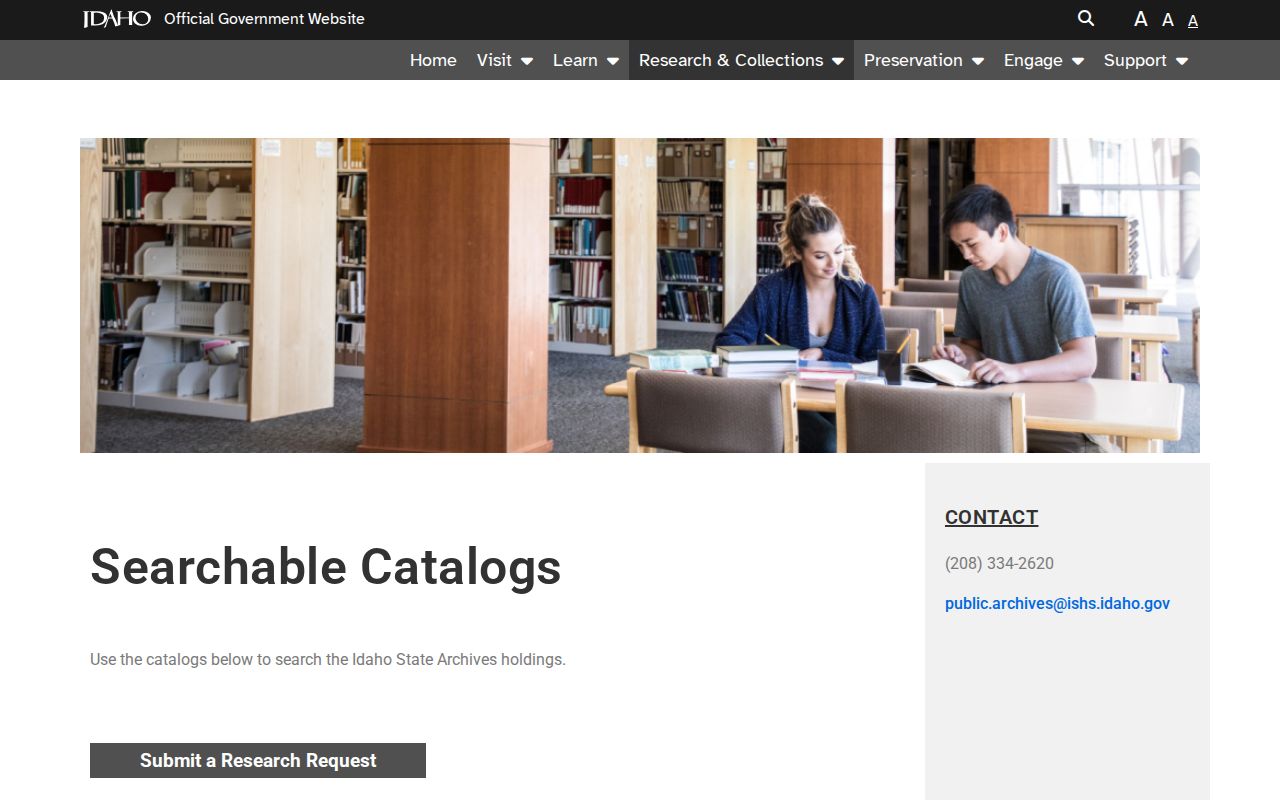
This catalog view is best used to identify a collection title or finding aid before contacting the reading room, not as proof that every volume has been scanned.
The State Archives reading room is at 2205 Old Penitentiary Road in Boise and is open Wednesday through Saturday, 10:00 a.m. to 4:30 p.m. Appointments are encouraged. The first 30 minutes of staff reference help are free; extra work, up to two hours, is $25 per half-hour. Email public.archives@ishs.idaho.gov or call 208-334-2620.
Boise Names Beyond Directories
The State Archives searchable indexes fill gaps that a Boise city directory cannot. The Idaho Biographical Index points to names in state and local histories, periodicals, and selected newspaper articles. The reconstructed 1890 Idaho Census is especially useful because the federal census for that year is missing. It combines evidence from 1885 through 1894, including births, marriages, deaths, wills, land and tax files, court matters, mining and water rights, naturalization, newspapers, and Boise directories.
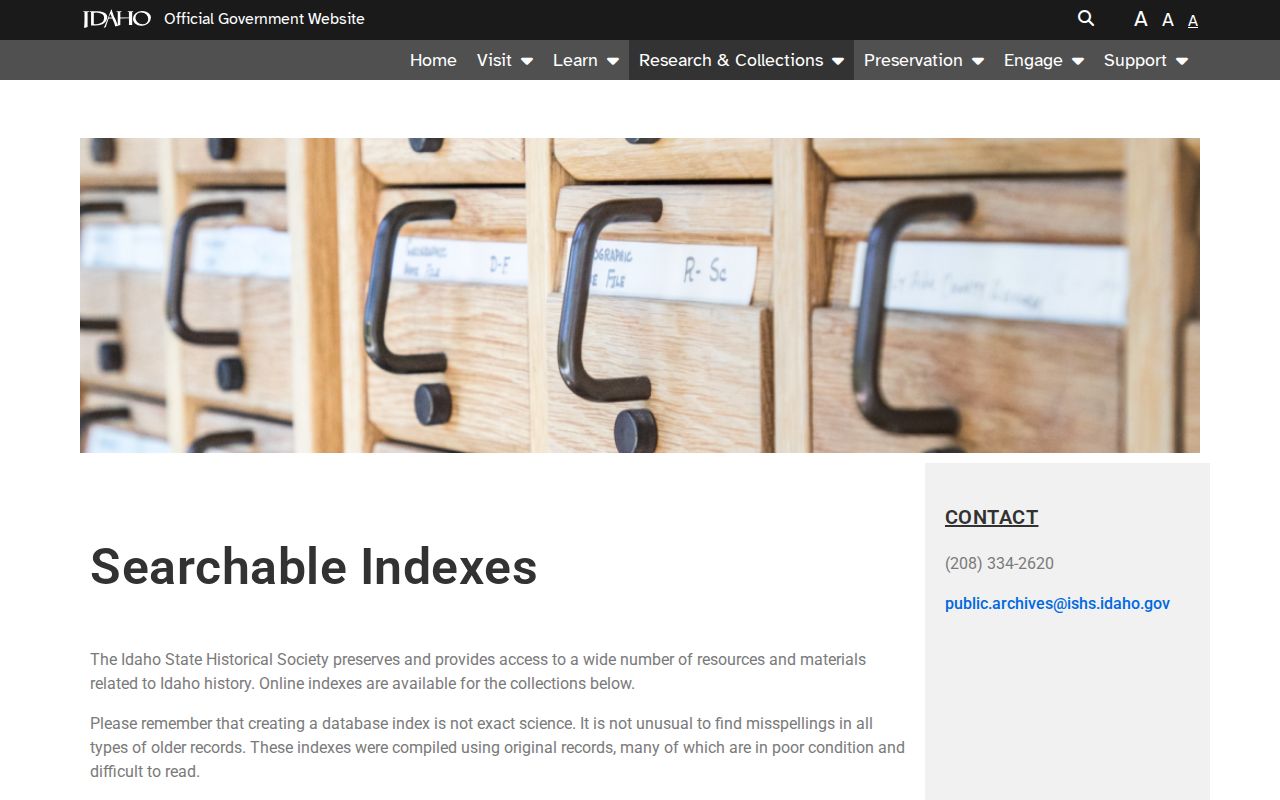
The screenshot shows an index route, so treat each hit as a pointer to an underlying source. Ask for the cited record or image before stating that a person lived at a Boise address.
The Idaho State Archives also holds microfilmed newspapers, government records, family histories, and maps.
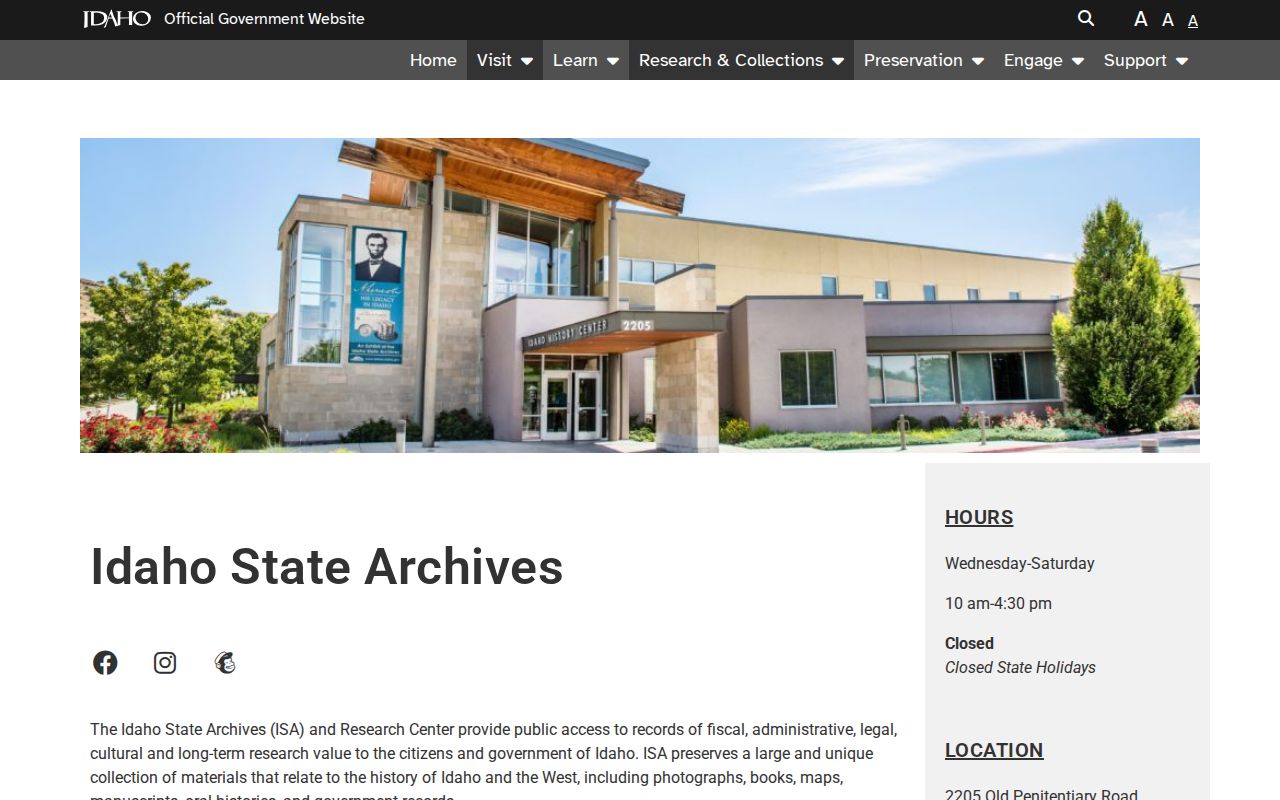
The archive page confirms the reading-room and staff-help channel when the catalog or online index is not enough.
Boise Directory Time Markers
The shelf crosses several changes in how Boise names and addresses were recorded. These dates help choose the next source when the city directory run is thin.
| Year | Boise record milestone |
|---|---|
| 1863-1867 | Boise was founded and platted, became the territorial capital, and gained the survey language tied to the Boise Meridian. |
| 1891 | The library's listed Polk directory run begins. |
| 1895 and 1905 | The library opened in City Hall, then moved to the Carnegie building. |
| 1948 | The library's telephone-book holdings begin. |
| Later twentieth century | Hill-Donnelly cross-reference runs add street-led research alongside name-led volumes. |
This sequence also explains a useful contrast. Boise Library's Polk holdings start in 1891, while the recorder portal displayed online index coverage beginning in 1982 during the research inspection. The historical shelf reaches about nine decades earlier than that web index snapshot.
Map Boise Directory Addresses
A street line becomes more useful when it is placed on a map from the same era. Idaho's historical research guidance lists Boise Sanborn fire-insurance maps for 1884, 1888, 1893, 1912, 1956, 1959, and 1976, along with several pasteover revisions. A pasteover is an update attached to an older map sheet. It can show how a block or building changed without creating a wholly new edition. The Idaho State Archives provides hardcopy, microfilm, and digital access, while the Library of Congress has a Boise 1956 sheet gallery.
Match the house number and street as printed in the city directory. Then compare the map's sheet number, block shape, and building outline. Boise and Ada County address rules can change numbers that are out of sequence, off a main road, or on the wrong parity side. Four county numbering grids also use different zero points. If the old and modern addresses conflict, check plats, city maps, and directory years on both sides of the change. Do not force a modern number onto a nineteenth-century entry.
Newspapers add names and dates to the mapped place. The library advertises Idaho Statesman coverage from July 26, 1864 to the present and an obituary index for 1957 through 2017. Announcements, property notices, civic events, and death notices can explain why a person first appears or vanishes from a Boise city directory. Yet a newspaper notice may omit a full household. Cite it as a notice, not as a directory substitute.
Trace Families in Boise Directories
Follow a household through more than one source. A Boise city directory line can place a name at an address for one year, but a map, census substitute, obituary, or deed can test the connection. Keep uncertainty visible when years are missing.
- Choose the nearest available year and copy the entry, publisher, page, and abbreviation key.
- Check the prior and next available volumes. Note every spelling, address, phone, and household change.
- Use a cross-reference volume to test the street address. For current street work, move to the Boise street directory.
- Pair the time span with a census year or the reconstructed 1890 index, then check newspapers and obituary files.
- Use a Sanborn sheet, deed, cemetery record, or archive file as a second source before stating a residence.
Boise Sanborn map editions and pasteovers include 1884, 1888, 1893, several early twentieth-century revisions, 1956, 1959, and 1976. They can show a structure and old street context, not who lived inside. For very early Boise residents, Pioneer Cemetery markers and newspapers may predate systematic state death recording.
Source discipline. Pair at least two independent records and describe each finding as listed, indexed, recorded, or mapped for a stated year.